Hello Quarto
Hello Quarto: A World of Possibilities
(for Reproducible Publishing)
Duke University + Posit
2023-06-06
Pre-workshop instructions
While you wait for the workshop to begin…
Decide which option you prefer and follow the steps.
Option 1: Own setup
Download and install the latest versions of R, RStudio, and Quarto:
- R
4.2or above: https://cran.r-project.org - RStudio
2023.03.1+446or above: https://posit.co/download/rstudio-desktop - Quarto
1.3.354or above: https://quarto.org/docs/get-started
- R
Install the following packages:
- Download
exercises.zipat https://mine.quarto.pub/quarto-monash/exercises.zip and unzip it on your Desktop or somewhere you can easily locate on your computer. Then, double click onexercises.Rprojto open the RStudio Project.
Option 2: Posit Cloud
Click here to join the Posit Cloud space for the workshop. Log in using Google, GitHub, or Posit (e.g., shinyapps.io or Posit Cloud) authentication, join the space, and then click on Content on the top navigation bar.
Welcome
About me
Mine Çetinkaya-Rundel
Professor of the Practice, Duke University - Statistical Science
Developer Educator, Posit
R Markdown users/educators for 10+ years, Quarto users/educators for 1+ years
About you
Meet 1-2 people around you!
01:00
Workshop structure
My turn: Lecture segments + live coding
Our turn: Live coding + follow along
Your turn: Exercises
Getting help / questions
Don’t hesitate to raise your hand to ask a question throughout the workshop
I might be able to answer / help on the spot, or wait till the next “your turn” break to do so
Hello Quarto
Meeting you where you are
I’ll assume you
know some R
have worked in RStudio
want to learn about Quarto
I’ll teach you
Quarto syntax and formats
More Markdown
Even more R along the way!
Checking in one more time
Have you completed the following?
Decide which option you prefer and follow the steps.
Option 1: Own setup
Download and install the latest versions of R, RStudio, and Quarto:
- R
4.2or above: https://cran.r-project.org - RStudio
2023.03.1+446or above: https://posit.co/download/rstudio-desktop - Quarto
1.3.354or above: https://quarto.org/docs/get-started
- R
Install the following packages:
- Download
exercises.zipat https://mine.quarto.pub/quarto-monash/exercises.zip and unzip it on your Desktop or somewhere you can easily locate on your computer. Then, double click onexercises.Rprojto open the RStudio Project.
Option 2: Posit Cloud
Click here to join the Posit Cloud space for the workshop. Log in using Google, GitHub, or Posit (e.g., shinyapps.io or Posit Cloud) authentication, join the space, and then click on Content on the top navigation bar.
Let’s get started!
What is Quarto?
Quarto …
- is a new, open-source, scientific, and technical publishing system
- aims to make the process of creating and collaborating dramatically better
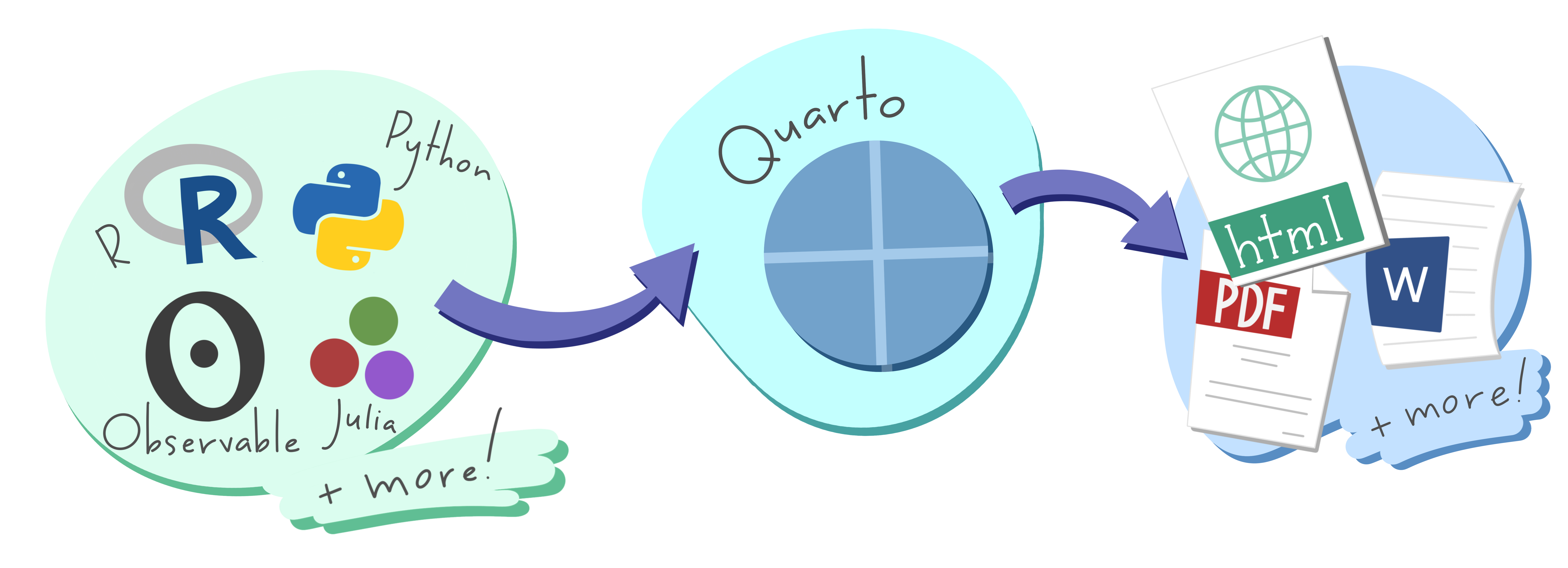
Artwork from “Hello, Quarto” keynote by Julia Lowndes and Mine Çetinkaya-Rundel, presented at RStudio Conference 2022. Illustrated by Allison Horst.
Quarto
With Quarto you can weave together narrative text and code to produce elegantly formatted output as documents, web pages, blog posts, books and more.
just like R Markdown…
but not just like it, there’s more to it…
Quarto …
unifies + extends the R Markdown ecosystem
Quarto …
unifies + extends the R Markdown ecosystem
unifies for people who love R Markdown
Quarto …
unifies + extends the R Markdown ecosystem
unifies for people who love R Markdown
extends for people who don’t know R Markdown
Quarto unifies + extends R Markdown
- Consistent implementation of attractive and handy features across outputs: tabsets, code-folding, syntax highlighting, etc.
- More accessible defaults as well as better support for accessibility
- Guardrails, particularly helpful for new learners: YAML completion, informative syntax errors, etc.
- Support for other languages like Python, Julia, Observable, and more via Jupyter engine for executable code chunks.
A tour of Quarto
Sit back and enjoy!
Your turn
Open hello-penguins.qmd in RStudio and with the visual editor. Render the document. Update your name and re-render. Inspect components of the document and make one more update and re-render. Compare notes with neighbors about updates you’ve made and note any aspects of the document that are not clear after the tour and your first interaction with it.
05:00
Quarto CLI
Revisit: What is Quarto?
Quarto is a command line interface (CLI) that renders plain text formats (.qmd, .rmd, .md) OR mixed formats (.ipynb/Jupyter notebook) into static PDF/Word/HTML reports, books, websites, presentations and more.
mine$ quarto --help

  Usage:   quarto
  Version: 1.3.353

  Description:

    Quarto CLI

  Options:

    -h, --help     - Show this help.
    -V, --version  - Show the version number for this program.

  Commands:

    render          [input] [args...]     - Render files or projects to various document types.
    preview         [file] [args...]      - Render and preview a document or website project.
    serve           [input]               - Serve a Shiny interactive document.
    create          [type] [commands...]  - Create a Quarto project or extension
    create-project  [dir]                 - Create a project for rendering multiple documents
    convert         <input>               - Convert documents to alternate representations.
    pandoc          [args...]             - Run the version of Pandoc embedded within Quarto.
    run             [script] [args...]    - Run a TypeScript, R, Python, or Lua script.
    add             <extension>           - Add an extension to this folder or project
    install         [target...]           - Installs an extension or global dependency.
    publish         [provider] [path]     - Publish a document or project. Available providers include:
    check           [target]              - Verify correct functioning of Quarto installation.
    help            [command]             - Show this help or the help of a sub-command.
Quarto, more than just knitr
We learned from 10 years of literate programming with knitr + rmarkdown
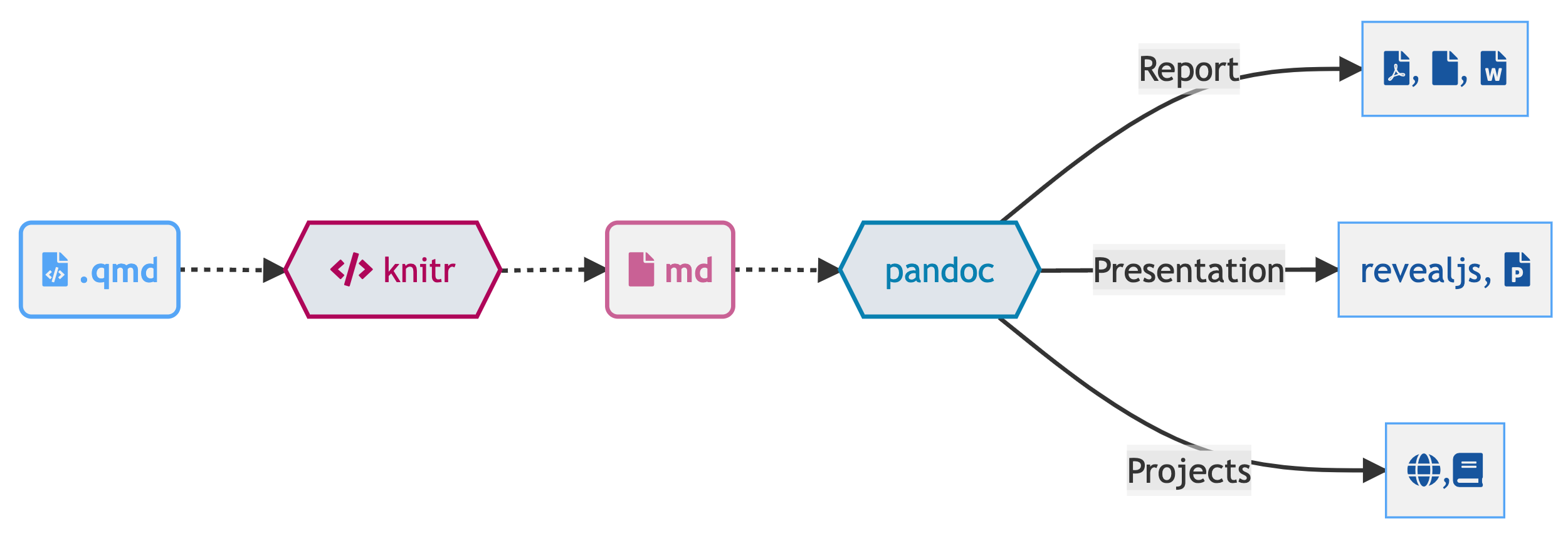
Quarto, more than just knitr
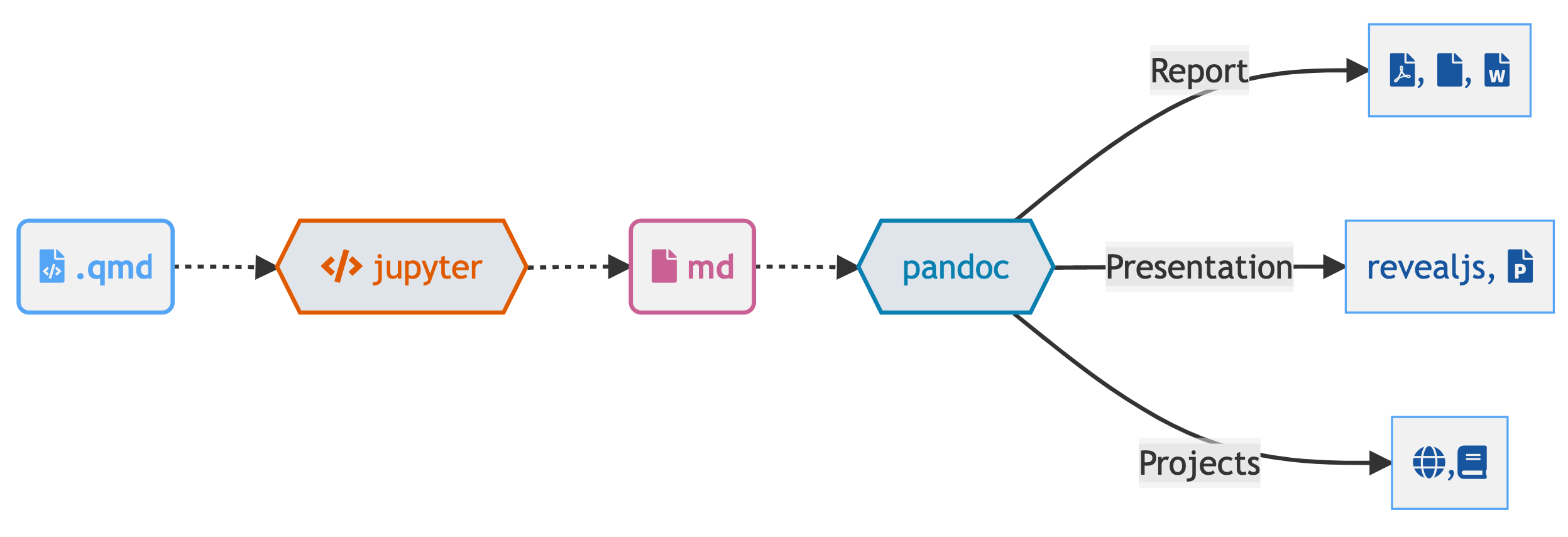
Quarto: More than just knitr

Under the hood
knitrorjupyterevaluates R/Python/Julia code and returns a.mdfile along with the evaluated code- Quarto applies Lua filters + CSS/LaTeX which is then evaluated alongside the
.mdfile by Pandoc and converted to a final output format
Aside: Lua filters
- Here is an example of a Lua filter that converts strong emphasis to small caps, from https://pandoc.org/lua-filters.html:
- Lua filters written by R/Python/Julia developers should be interchangeable between formats - not language specific!
- We won’t go into the details of writing Lua filters in this workshop, and you don’t need to worry about learning about Lua filters unless you’re working on extending Quarto.
From the comfort of your own homeworkspace
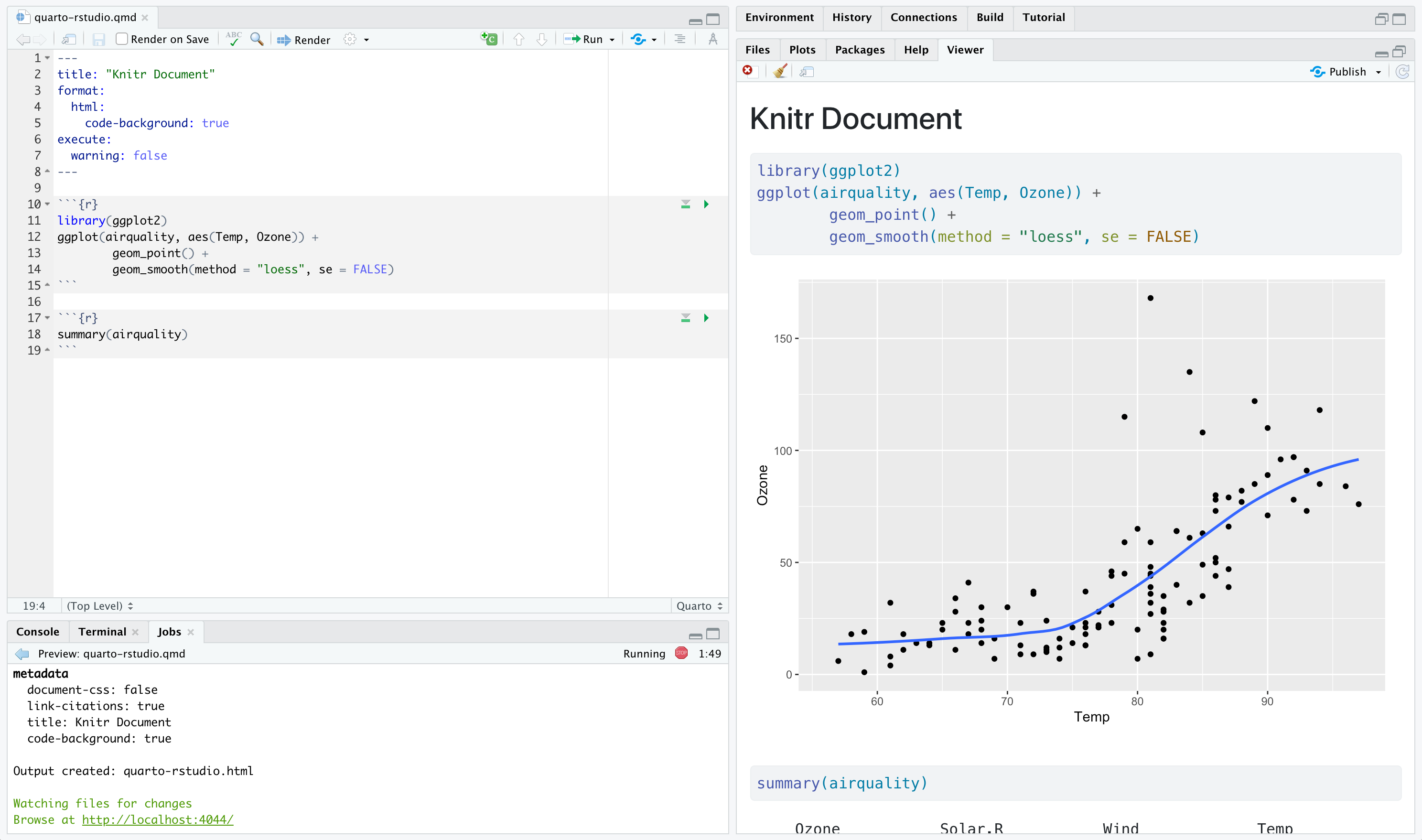
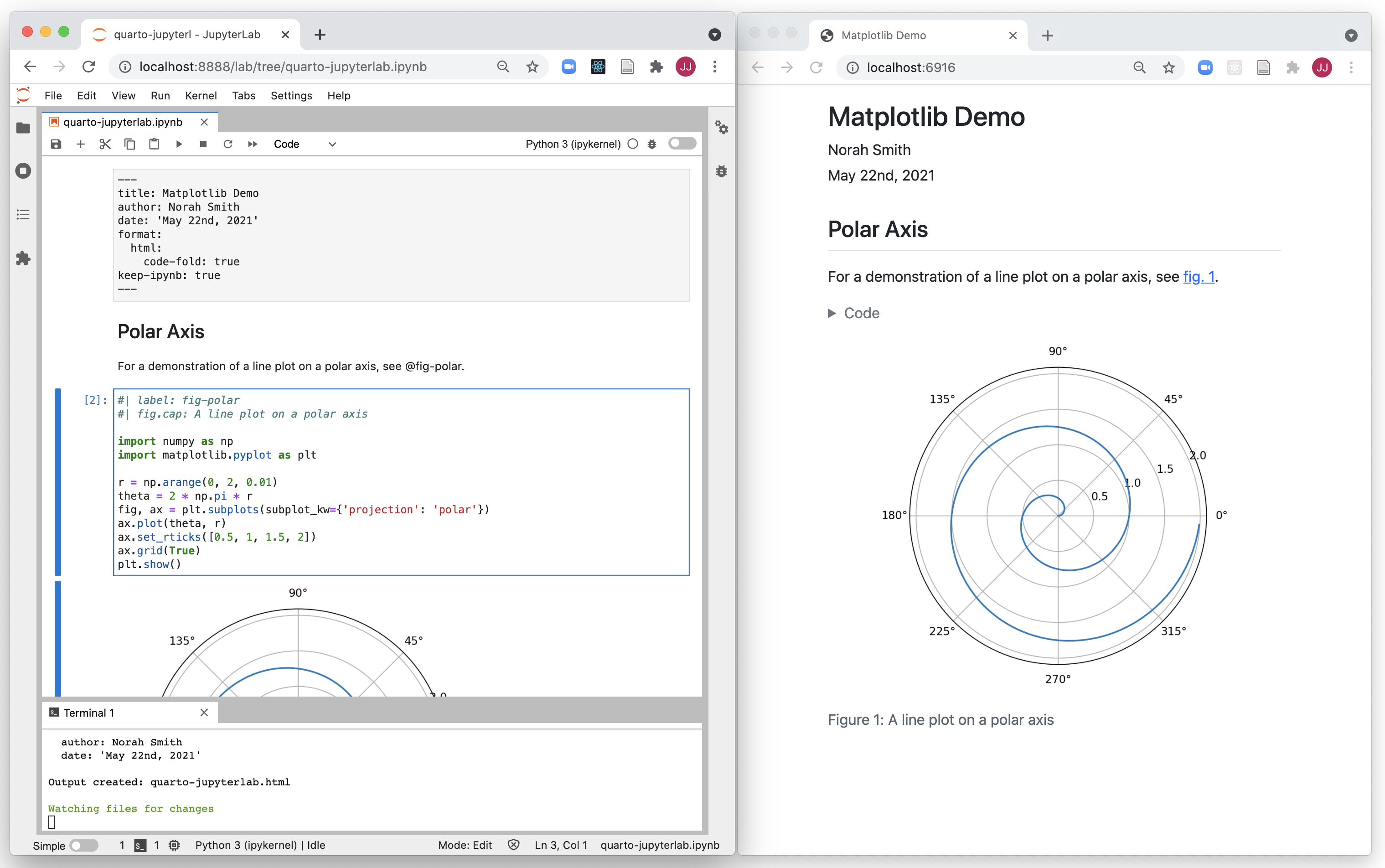
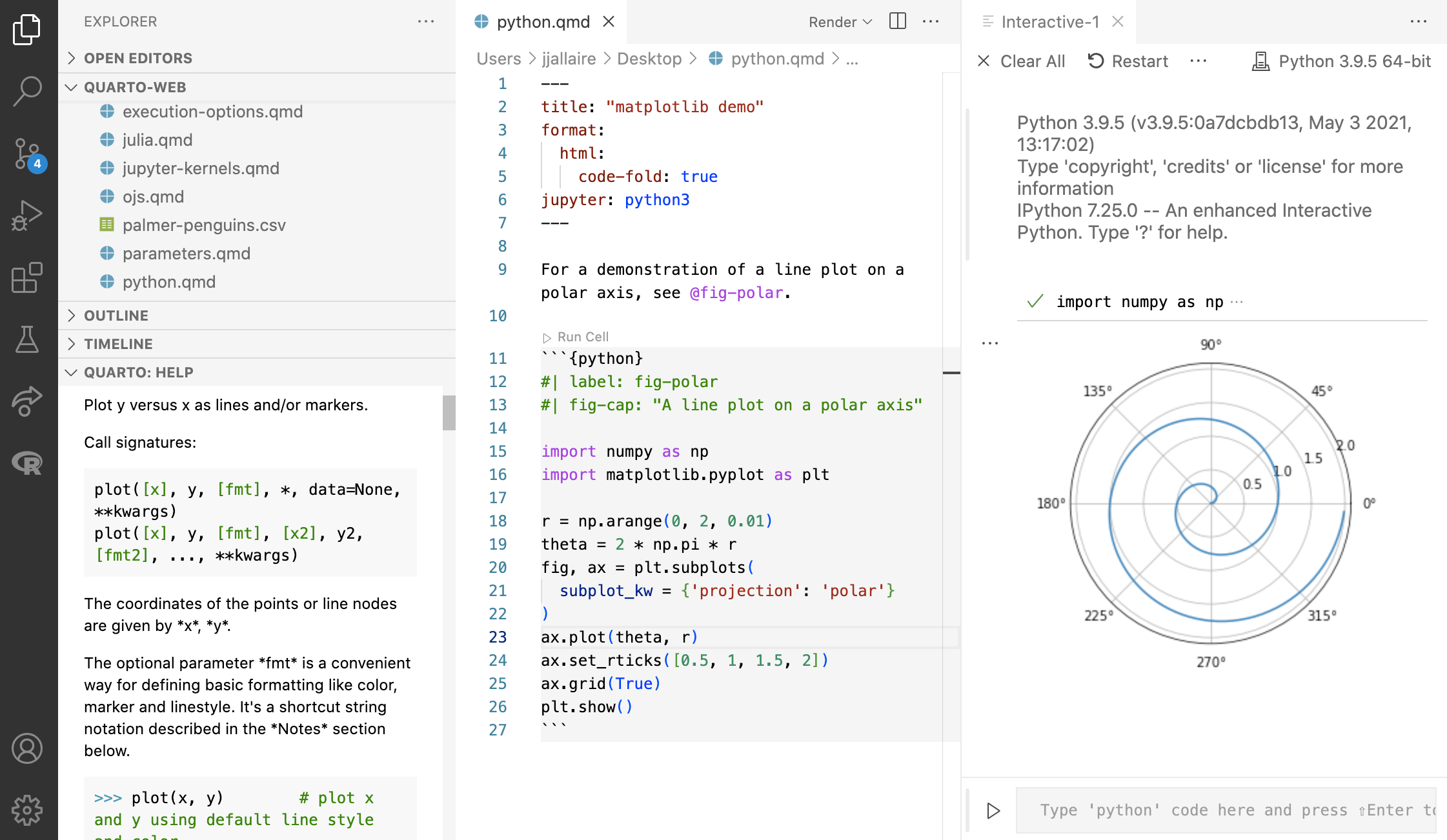
Navigating within RStudio
Quarto workflow
Rendering a Quarto file in RStudio via the Render button calls quarto render in a background job, preventing Quarto rendering from cluttering up the R console, and gives you and easy way to stop:

Rendering
- Option 1: In RStudio as a background job, and preview the output.
- Option 2: In the Terminal via
quarto render:
Quarto formats
One install, “Batteries included”
- RMarkdown grew into a large ecosystem, with varying syntax.
Quarto comes “batteries included” straight out of the box
- HTML reports and websites
- PDF reports
- MS Office (Word, Powerpoint)
- Presentations (Powerpoint, Beamer,
revealjs) - Books
- Any language, exact same approach and syntax
Many Quarto formats
| Feature | R Markdown | Quarto |
|---|---|---|
| Basic Formats | ||
| Beamer | beamer_presentation | beamer |
| PowerPoint | powerpoint_presentation | pptx |
| HTML Slides | revealjs | |
| Advanced Layout | Quarto Article Layout |
Many Quarto formats
| Feature | R Markdown | Quarto |
|---|---|---|
| Cross References | Quarto Crossrefs | |
| Websites & Blogs | ||
| Books | bookdown | Quarto Books |
| Interactivity | Shiny Documents | Quarto Interactive Documents |
| Journal Articles | rticles | Journal Articles |
| Dashboards | flexdashboard | Coming soon! |
Your turn
In RStudio, go to File > New File > Quarto document to create a Quarto document with HTML output. Render the document, which will ask you to give it a name – you can use my-first-document.qmd.
Use the visual editor for the next steps.
Add a title and your name as the author.
Create two sections, one with fact you want to learn and your favorite thing about R.
Add a table of contents.
Stretch goal: Change the html theme to
sketchy.
05:00
Wrap up
What about R Markdown?
You can render existing R Markdown documents with Quarto and you can rename them to
.qmdfiles to turn them into Quarto documents.You don’t have to do this – R Markdown continues to be maintained.
However, new features are being developed for Quarto.
Additionally, Quarto
Offers “batteries included” shared syntax across formats
Allows you to choose your own editor and your preferred data science language
Comes with richer and more accessible features out of the box
Is actively developed
Questions
Any questions / anything you’d like to review before we wrap up this module?
One last thing!
Where does the name “Quarto” come from?